
How Long Do Roses Last? A Florist's Guide to Making Cut Flowers Last Twice as Long
In this article
- How Long Do Roses Actually Last?
- The Arrival Ritual: First Hour Sets the Whole Week
- Vase Choice and Water Depth
- The Daily (and Every-Other-Day) Care Routine
- Common Mistakes That Kill Roses Fast
- Myth-Busting: What Actually Works in the Vase Water?
- When Should You Throw Roses Away?
- Order Roses That Arrive Built to Last
A bouquet of cut roses typically lasts five to seven days. With a bit of method — the kind of method any florist runs through on autopilot — you can comfortably double that to ten to fourteen. The difference isn't a secret ingredient. It's a clean vase, a sharp pair of scissors, and a willingness to ignore most of the kitchen-cupboard tricks the internet swears by.
This is the florist's playbook for keeping cut roses alive twice as long, plus an honest verdict on aspirin, sugar, vodka, copper coins, and the rest of the folklore. We've checked the receipts.
How Long Do Roses Actually Last?
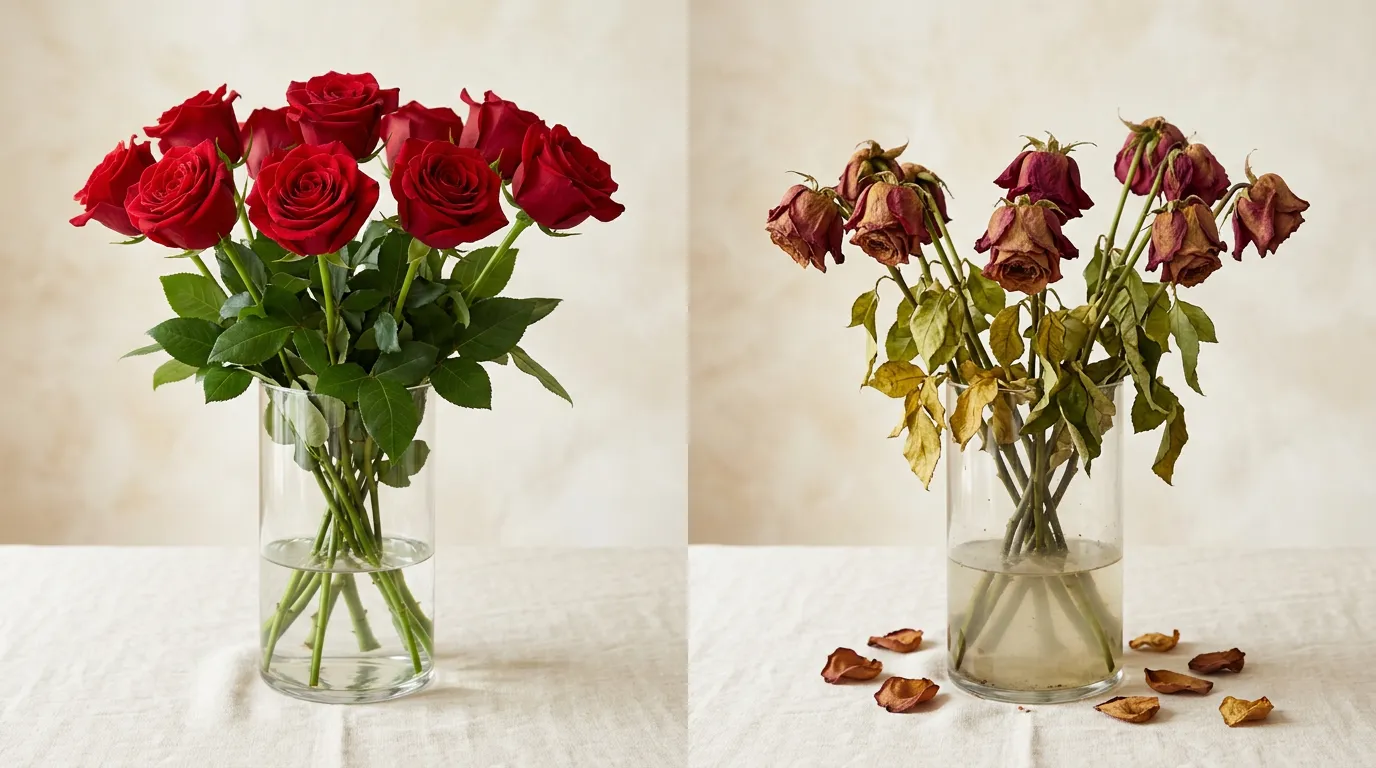
The honest answer: five to seven days from the average vase, ten to fourteen days with proper care. A handful of factors decide where on that spectrum your bouquet lands, and most of them are inside your control.
- Variety. Standard hybrid tea roses (the long-stemmed classics) typically hold for 7-12 days. Spray roses (multiple smaller heads per stem) can push 10-14. Garden roses look glorious for about 4-6 days then fade fast — beauty has a price.
- Age at delivery. Supermarket roses have often spent a week in the supply chain before they reach your kitchen. Florist-direct roses arrive within a day or two of being cut. The clock started ticking before you got involved.
- Water quality. Bacteria in cloudy vase water blocks the stem like a clogged drain. Clean water is non-negotiable.
- Temperature. Roses evolved as cool-climate plants. A vase on a sunny windowsill in a Cape Town summer is essentially a slow oven.
- Light and ethylene. Direct sun accelerates ageing. So does proximity to a fruit bowl — ripening fruit (especially bananas, apples, pears) gives off ethylene gas, which makes flowers wilt faster. Real thing, not a myth.
The takeaway: if your roses keep dying on day four, the problem isn't the florist. It's almost always the water, the temperature, or the spot you've put them in.
The Arrival Ritual: First Hour Sets the Whole Week
What you do in the first hour after a bouquet arrives matters more than anything you do later. Here's the four-step ritual every florist runs through.
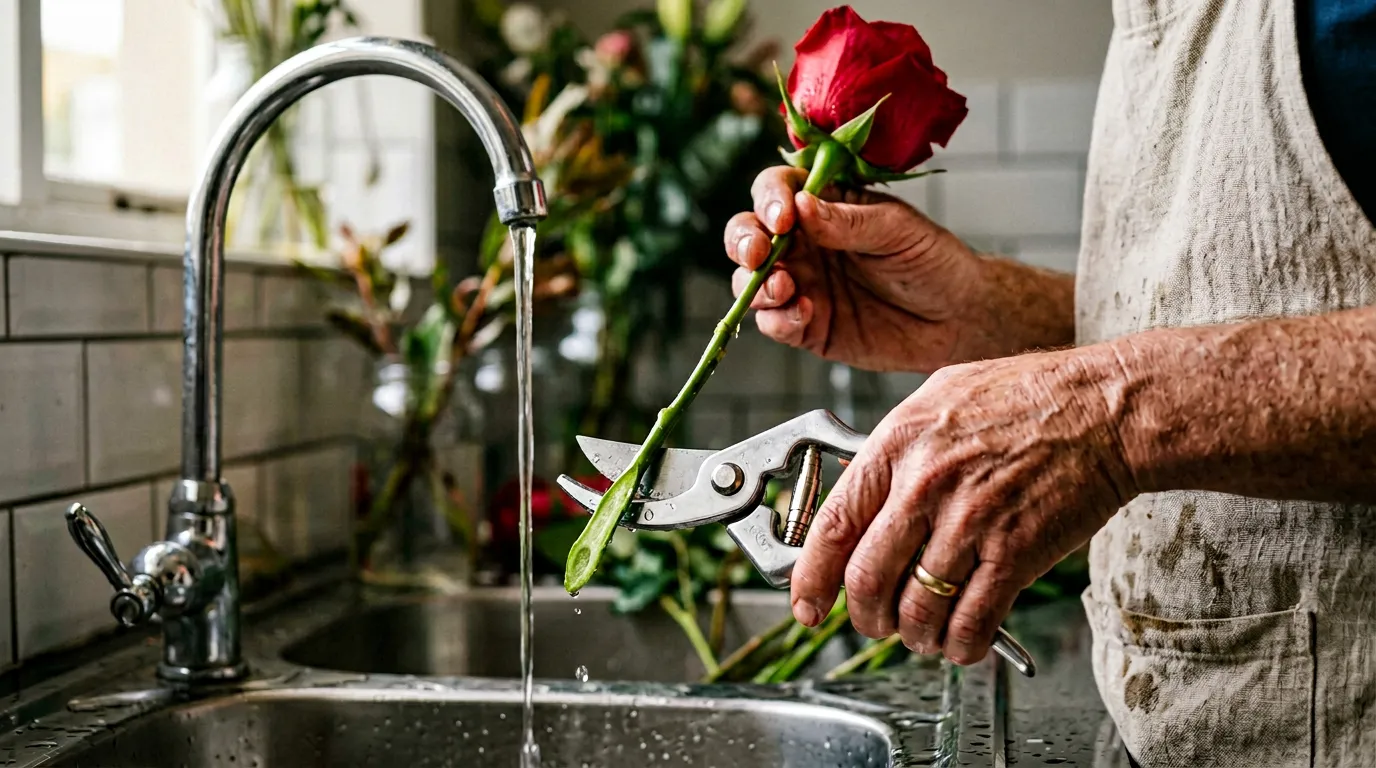
1. Recut every stem at a 45-degree angle
Take 1-2 cm off the bottom of each stem with sharp scissors or secateurs (not blunt kitchen scissors — they crush the stem and slow water uptake). The 45-degree angle does two things: it exposes a slightly larger drinking surface than a flat cut, and it stops the stem from sealing flat against the bottom of the vase. Re-cut under running water if you can manage it. The moment a stem is cut, it draws air; that air pocket (an embolism) blocks water uptake for the rest of the bouquet's life. Cutting under water prevents the air gulp.
2. Strip every leaf that will sit below the waterline
Submerged leaves rot within a day, the water turns murky, and bacteria population doubles every few hours. The Royal Horticultural Society explicitly recommends stripping leaves from the bottom half to two-thirds of every stem. Florists do this without thinking. Most home arrangers skip it and wonder why their bouquet smells like a pond by Tuesday.
3. Use cool — not cold, not hot — water
Lukewarm water (around 20-25°C) is the sweet spot for most cut flowers, including roses. The lone exception is a drooping, soft-stemmed bouquet — the RHS recommends a brief 20-30 second dip of the bottom 2.5 cm of stems in near-boiling water to clear an air blockage and revive them. For a fresh bouquet straight from the florist, plain cool tap water is fine. Cold-from-the-fridge water shocks tropical flowers; hot water dissolves more oxygen out of solution. Cool and comfortable is the rule.
4. Skip the floral foam if it's just a vase
If your bouquet didn't arrive in foam, don't add it. Foam slows water uptake compared to a clean glass vase. Use the foam for sculptural arrangements; otherwise, fresh water is faster.
Vase Choice and Water Depth
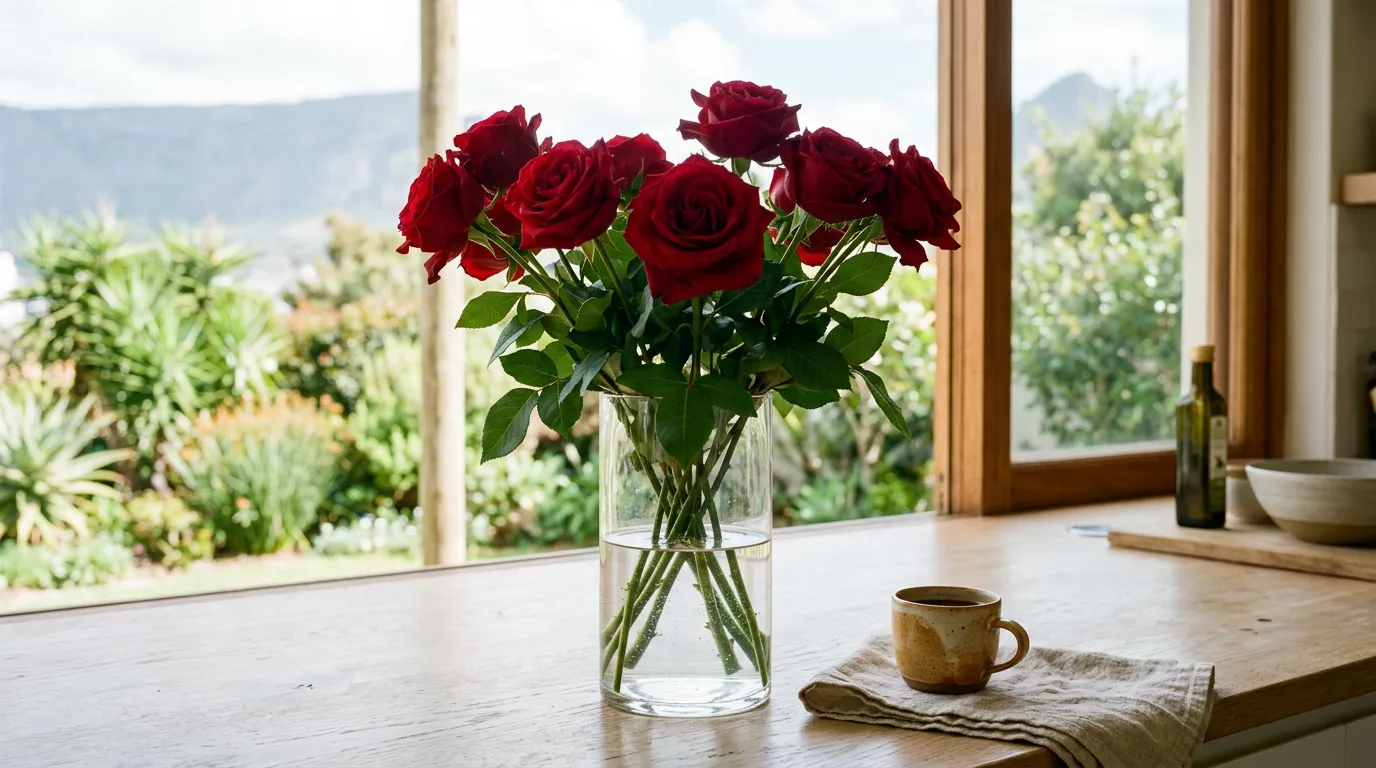
The vase matters more than people realise. A few quick rules:
- Clean. Wash with warm soapy water before every new bouquet. Bacterial film from the last arrangement will colonise this one.
- The right size. A vase that's too tight crushes stems and prevents water flow around them. Too wide and the stems flop. The classic test — bouquet height should be roughly 1.5 to 2 times the vase height.
- Water depth. Fill to about two-thirds full. Roses drink heavily — a fresh bouquet can lower the waterline by a centimetre or more overnight. Top up daily.
- Material doesn't really matter. Glass lets you spot cloudy water early; ceramic looks better but you'll need to peek inside more often. Either works.
The Daily (and Every-Other-Day) Care Routine
This is where 80% of bouquets are lost. The first-day ritual sets the bouquet up; the routine keeps it alive.
- Top up the water daily. Roses are thirsty. The water level should never drop below the bottom third of the stems.
- Change the water completely every 2-3 days. Tip the old water out, wash the vase with warm soapy water, fill with fresh cool water. Skip this and bacteria win on day four.
- Recut the stems every time you change the water. Just half a centimetre. Stems seal over with bacteria and dried sap; recutting reopens the drinking channel. The RHS recommends this every two to four days.
- Use the flower food sachet that came with the bouquet. Commercial cut-flower preservatives (Chrysal is the industry standard) are not gimmicks. A peer-reviewed International Society for Horticultural Science study on cut roses found commercial flower food extended vase life from 7.4 days (plain tap water) to 9.6 days — a 30% improvement (we'll cite the full study in the myth-busting section below). The sachet is doing real work: it provides sugar for the bloom, an acidifier to lower water pH (which helps uptake), and a biocide to kill bacteria. If you've used the sachet up, dose another one when you change the water.
- Move them somewhere cool overnight. If you're feeling enthusiastic, the fridge adds 3-5 days to a bouquet's life — overnight cooling slows the ageing rate. A cool spare room works almost as well.
- Keep them away from heat, sun, and fruit. No radiators, no Cape Town windowsills in February, no shelf above the fruit bowl.
Common Mistakes That Kill Roses Fast
The five fastest ways to murder a bouquet, in our professional experience:
- Leaves left underwater. Single biggest unforced error. The bouquet rots from the bottom.
- Never changing the water. By day four the vase is essentially a bacterial culture experiment, and the stems can no longer draw any of it up.
- Cutting stems with blunt scissors. Crushed stems can't drink. Use sharp blades, every time.
- Putting them next to the kettle, the toaster, or the fruit bowl. Heat and ethylene are both quiet killers.
- Ignoring the sachet. The little packet of powder taped to the wrap is genuinely the most useful thing you can add to the water.
Myth-Busting: What Actually Works in the Vase Water?
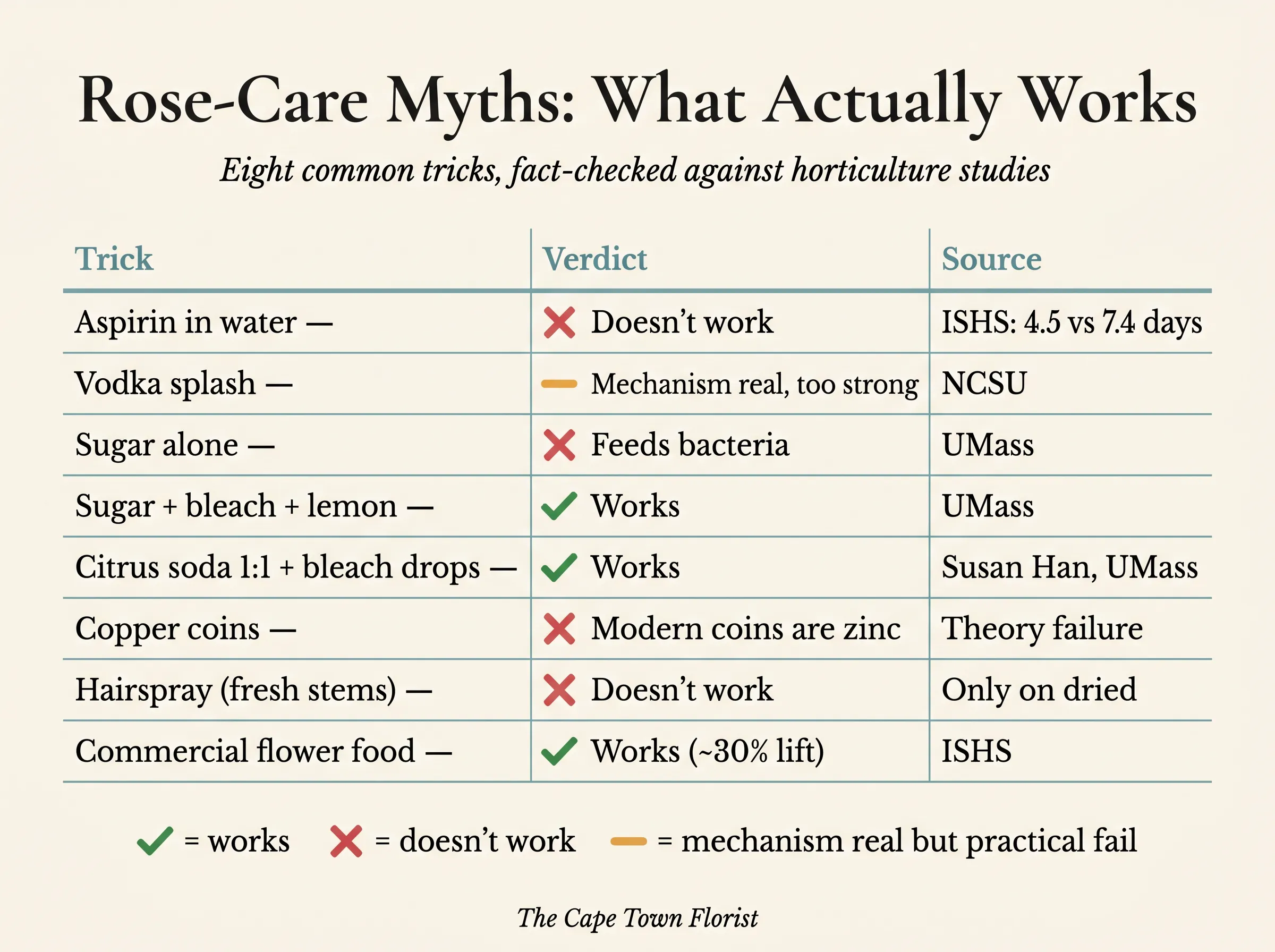
Every florist gets asked this. The internet is awash with kitchen-cupboard "tricks" — most are folklore, a couple have a kernel of truth, and one or two actively shorten the life of your bouquet. Here's the verdict, with sources.
Aspirin — DOES NOT WORK (and may shorten vase life)
The theory: aspirin lowers water pH, which helps stems take up water. The reality: an International Society for Horticultural Science study on six rose cultivars found that every aspirin treatment reduced shelf life compared to plain tap water — roses showed dried, necrotic leaves by day two and lasted an average of just 4.5 days, versus 7.4 in the water control and 9.6 with proper flower food. Verdict: skip it. If you want to lower pH, a few drops of lemon juice is a better bet (Purdue University rates it more effective than aspirin), but commercial flower food still beats both.
Vodka — TECHNICALLY YES, PRACTICALLY NO
Vodka can suppress ethylene production and acts as a mild antibacterial — both real mechanisms. Scientific American cites North Carolina State University's John Dole noting that store-bought vodka (40% alcohol) is far too concentrated — flowers tolerate up to about 8%, beyond which alcohol damages the stems. To get a useful concentration you'd need a teaspoon in a vase, and you've now wasted vodka and gained roughly nothing measurable. Verdict: drink the vodka, use the sachet.
Drink the vodka. Use the sachet.
Sugar alone — DOES NOT WORK (feeds bacteria)
Sugar is genuinely useful for bloom development, which is why it's in every commercial flower-food formula. But sugar on its own, without a biocide, is bacteria's dream brunch. The water turns cloudy within hours, the stems clog, and the bouquet dies faster than it would have in plain water. Sugar only works combined with something to kill bacteria (typically a few drops of bleach) and an acidifier (lemon juice or citric acid). Verdict: don't add sugar by itself; use the sachet.
Sugar on its own, without a biocide, is bacteria's dream brunch.
The DIY "sugar + bleach + lemon juice" recipe — ACTUALLY WORKS
If you've genuinely run out of flower food and want a homemade substitute: 1 teaspoon sugar, 2 tablespoons lemon juice, and a quarter teaspoon (3-4 drops) of household bleach per 1 litre of water. The sugar feeds the bloom, the lemon juice acidifies, and the bleach kills bacteria. Stick to the measurements — more bleach won't help and the fumes can irritate. Verdict: a passable backup, but commercial flower food is better-balanced.
Citrus soda (Sprite, 7Up) — WORKS, IF YOU MUST
Susan Han at the University of Massachusetts Amherst told Scientific American that a 1:1 mix of clear citrus soda and water (plus a few drops of bleach) works well — the soda provides sugar and citric acid, the bleach handles bacteria. Verdict: legitimately works, but you've now diluted a perfectly good bouquet with R30 of soft drink. Use the sachet.
Copper coins / pennies — DOES NOT WORK
The theory is that copper has antimicrobial properties (true). The problem is that modern coins (post-1982 in the US, and SA 5c coins were never high-copper) are mostly zinc with a thin copper plating. Even genuine copper coins release copper too slowly to make a measurable difference in vase water before the bouquet dies of other causes. Verdict: charming folklore, no measurable effect.
Hairspray on petals — ZERO EVIDENCE FOR FRESH FLOWERS
Hairspray is sometimes recommended to "preserve" cut flowers. It's used legitimately on dried flowers as a fixative. On fresh blooms it does nothing useful and can clog the petals' surface. Verdict: hairspray is for dried arrangements only.
When Should You Throw Roses Away?
The honest signal: when the heads start drooping irretrievably (the stem can't hold the weight of the bloom), when petals start dropping at a touch, or when the water smells. A single drooping rose in a bouquet of ten doesn't mean throw the lot — pull the dead one, recut the rest, refresh the water, and the survivors get a few more days. Don't be sentimental about a dead bouquet though; ageing flowers release ethylene that ages the rest of the bouquet faster.
Order Roses That Arrive Built to Last
Half the battle is getting roses that haven't already spent a week in transit. We deliver fresh red roses delivered same-day across Cape Town — every bouquet leaves us with stems freshly cut, the right preservative sachet, and care instructions in the box. Browse the full range of roses, or if it's a romance or anniversary occasion, our anniversary flower collection is built around the longest-lasting varieties. The flagship is Love Is A Bouquet Of Red Roses — a dozen velvety reds, the classic for a reason. Order before noon for same-day delivery.
From the florists
Send the story, not just the flowers.
Cape Town's freshest blooms — same-day delivery on weekday orders before noon, hand-arranged by florists who actually know the difference.
Shop the collectionEditor's picks
Featured arrangements


Frequently asked
Quick answers
How long do roses last in a vase?
Five to seven days for the average bouquet, ten to fourteen days with proper care. The biggest variables are how fresh the roses were when they arrived, water cleanliness, vase temperature, and whether you've removed leaves below the waterline and kept up with water changes.
What's the best thing to put in vase water for roses?
The flower-food sachet that came with the bouquet — it's a balanced mix of sugar (for the bloom), an acidifier (for stem uptake), and a biocide (to kill bacteria). Studies show commercial flower food extends rose vase life by around 30% versus plain water. Skip the aspirin, vodka, copper coins, and sugar-alone tricks; they don't work or actively shorten vase life.
Should I cut rose stems at a 45-degree angle?
Yes — the angled cut exposes more surface area and prevents the stem sealing flat against the vase bottom. Use sharp scissors or secateurs (not blunt kitchen scissors, which crush the stem) and recut under running water if possible to prevent an air bubble forming in the stem.
Does aspirin really keep roses fresh?
No — and it may shorten vase life. An International Society for Horticultural Science study found every aspirin treatment reduced rose shelf life compared to plain water, with roses showing necrotic leaves by day two. The aspirin myth is one of the most stubborn pieces of flower folklore, but the evidence is clear: skip it.
How often should I change the water in a rose vase?
Top up daily and do a complete water change every 2-3 days. The Royal Horticultural Society recommends recutting the stems each time you change the water — half a centimetre is enough to reopen the drinking channel.
Can I put roses in the fridge to make them last longer?
Yes — overnight cooling can add 3-5 days to a bouquet's life by slowing the ageing rate. Move the vase to the fridge before bed and back out in the morning. If fridge space is impractical, a cool spare room works almost as well.