What Are the Different Types of Lilies in South Africa?
In this article
Order lilies in Cape Town and you will be offered St Joseph, Stargazer, Asiflorum, Oriental, Asiatic and arum — six names for what looks, at a glance, like the same flower. They are not the same flower. Two of them are not even lilies. And one of those distinctions matters enormously if there is a cat in the house.
This is the guide we wish we could hand to everyone who rings up asking for “just some white lilies”. It covers what each type is, how to recognise it in a vase, how long it lasts, and which to keep away from your pets. Which of them is in season right now is a different question, answered in our month-by-month guide to what flowers are in season in Cape Town.
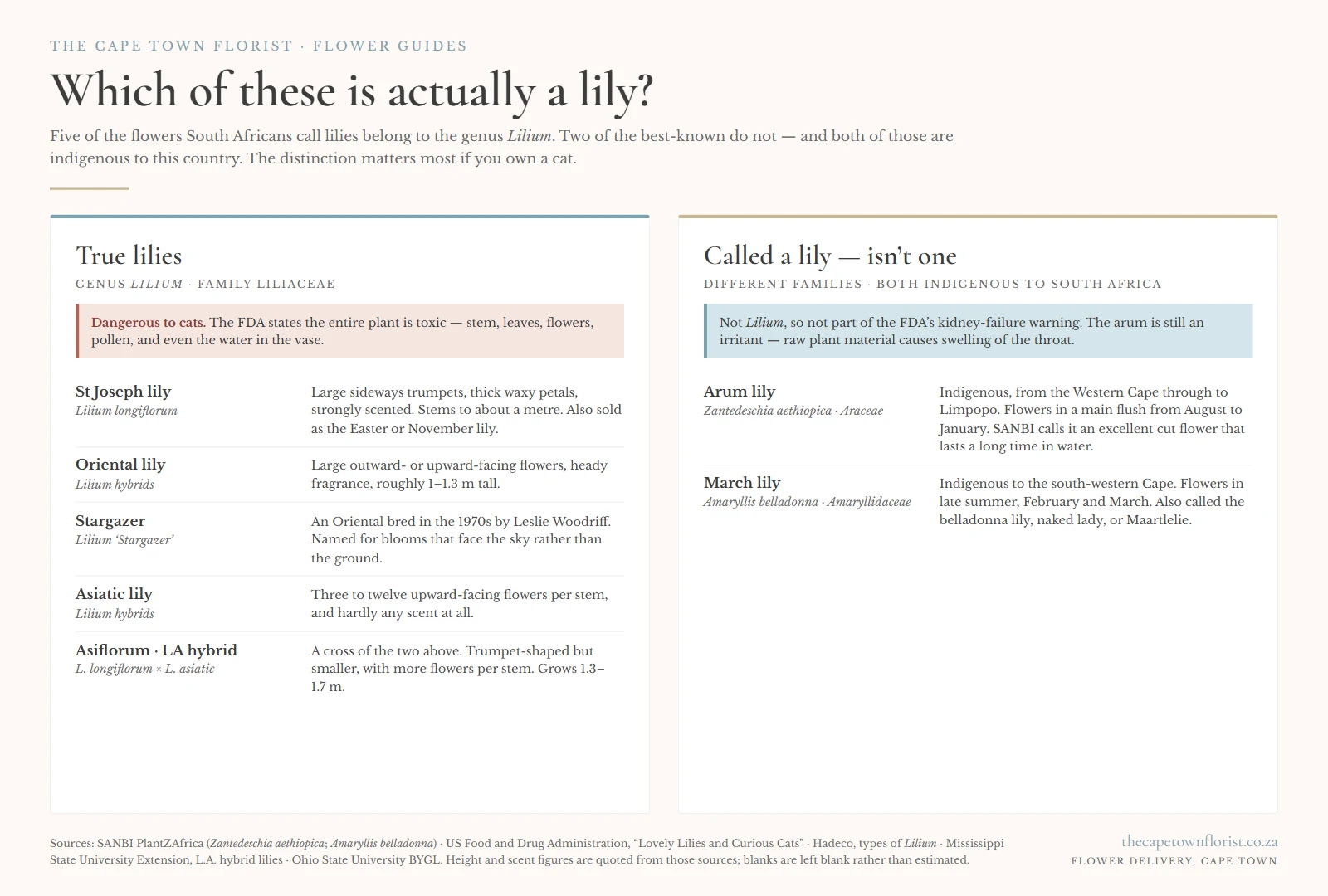
Five of the flowers South Africans call lilies belong to the genus Lilium. The two best-known exceptions grow wild here — and neither is a lily at all.
What Actually Counts as a Lily
A true lily is a member of the genus Lilium. It grows from a scaly bulb, throws up a single leafy stem, and carries several large six-petalled flowers with six prominent anthers at the centre. Every true lily in a South African florist's bucket is either a species like Lilium longiflorum or one of the hybrid groups bred from it.
Then there are the impostors. “Lily” is one of the most abused words in the flower trade, and South Africa has two celebrated examples: the arum lily and the March lily. Both are indigenous, both are lovely, and neither belongs to Lilium. This is not pedantry — the safety advice, the vase life and the season are all different, so the name changes what you do with the stems.
The Lily Types You'll Meet in South Africa
St Joseph Lily (Lilium longiflorum)
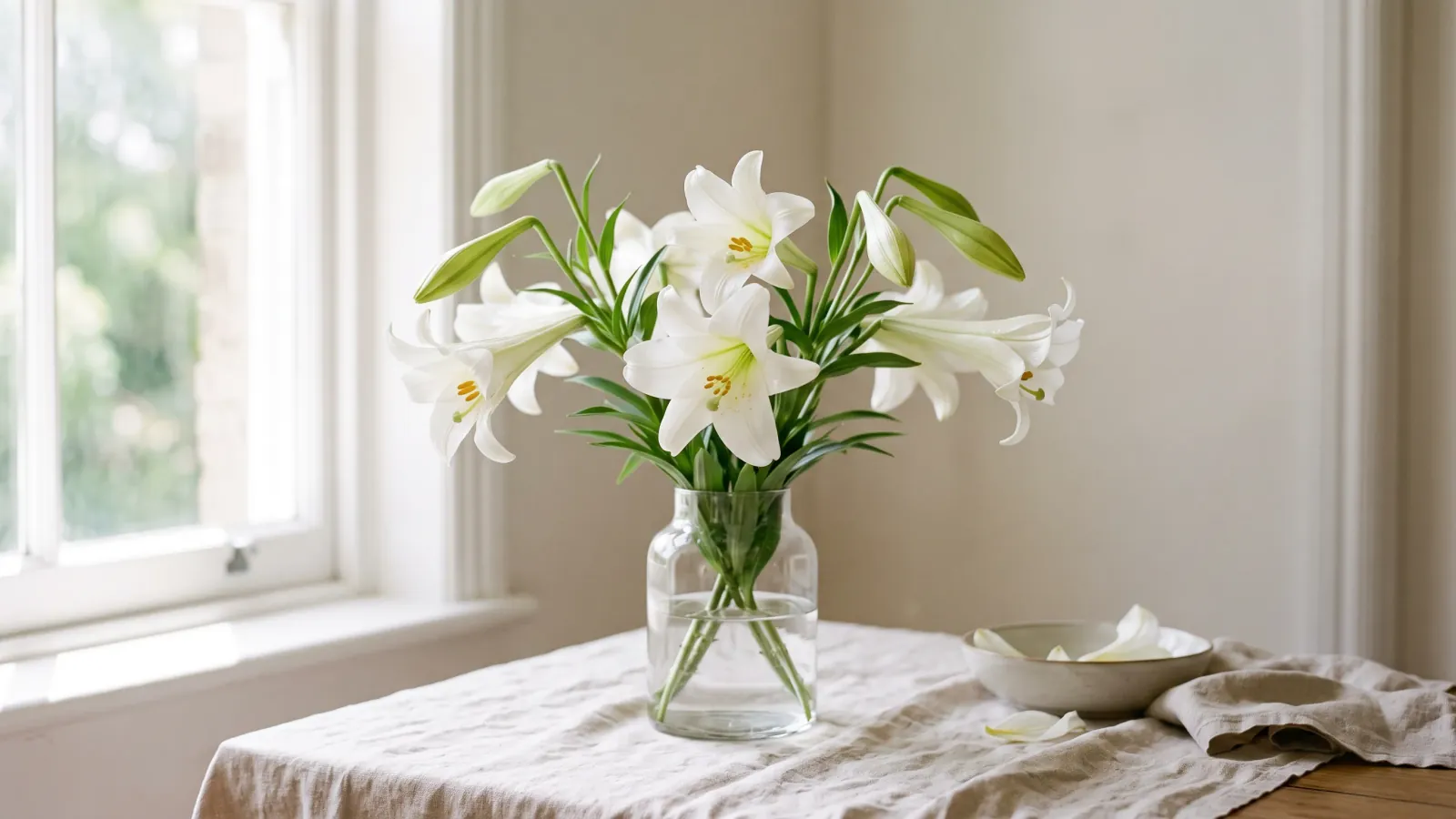
The big white trumpet. This is the flower most South Africans picture when someone says “lily”, and it is the one most often sent to funerals and hospitals. Botanically it is Lilium longiflorum. It travels under at least three other names: the Easter lily, the November lily, and, in the Johannesburg gardening press, the St Joseph lily. That last source describes “trumpet-shaped petals… filled with an intoxicating scent” on stems up to a metre high.
Hadeco, South Africa's largest bulb grower, describes the same plant more plainly: “Their sideways, large fragrant flowers have thick, waxy petals and deep trumpets.” That sideways carriage is the giveaway. A St Joseph lily points outward at you; an Asiatic points at the ceiling.
Because of its long association with sympathy and remembrance, this is the stem that anchors most of our sympathy and condolence arrangements. If you are sending one and are unsure about timing or wording, our guide to funeral flower etiquette in South Africa covers the awkward parts.
Oriental Lilies
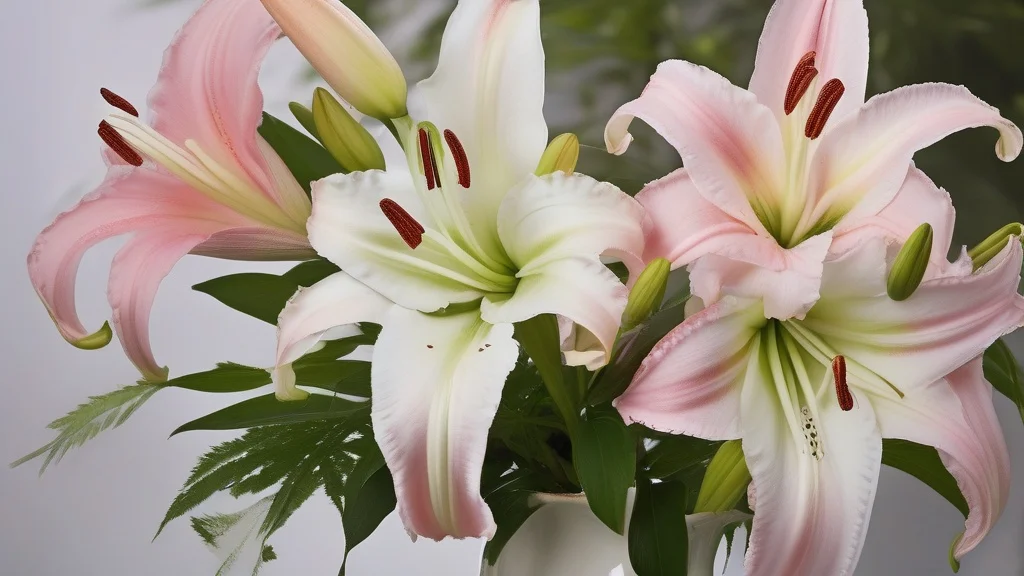
The heavyweights. Hadeco notes that Orientals “bloom later than L. asiatics and have a luxurious appearance with large, outward or upward facing flowers”, reaching “roughly 1 - 1.3m tall” and “known for their heady fragrance”. That fragrance is the point of an Oriental. One stem will scent a room; three will scent a house — which is either why you bought them or why you move them to the hallway.
Stargazer
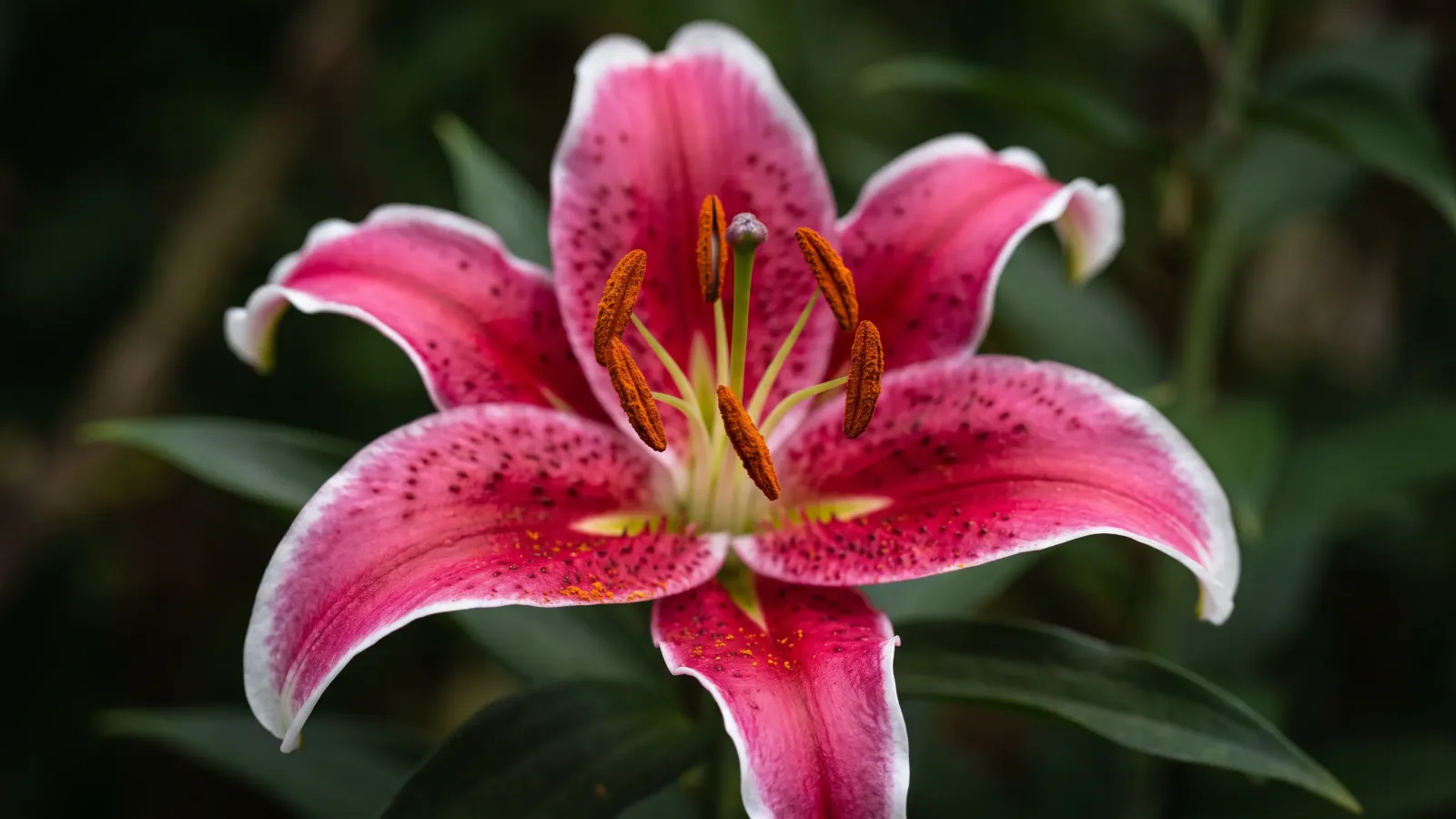
The most famous lily in the world, and an Oriental. Ohio State University’s horticulture extension describes it as part of a group “created in the 1970's by Leslie Woodriff”, who “called the new hybrid cross 'Stargazer' to reference the blooms facing towards the sky rather than the ground”. Before Stargazer, Oriental lilies hung their heads. Woodriff bred one that looked up, and the cut-flower trade never really looked back.
You will know it instantly: crimson-pink petals with white recurved edges, dark speckles, and six rust-orange anthers that will stain anything they touch.
Asiatic Lilies
The bright, cheerful, scentless one. Hadeco is blunt about it: “This variety has hardly any scent.” Their “most distinctive characteristics are the 3-12 (per stem) upward-facing flowers”. Illinois Extension makes the same comparison from the other direction — Asiatics “generally lack the heavy fragrance that others, like Oriental lilies, can possess”.
That absence is a feature, not a fault. Asiatics are the lily to send to an office, a hospital ward, or anyone who finds an Oriental overwhelming. They also come in oranges, yellows and hot pinks that Orientals simply do not do.
Asiflorum, or LA Hybrids
A deliberate cross between the two above. Hadeco calls the Asiflorum “a beautiful cross between L. longiflorum and L. asiatic”, growing to “a height of 1,3–1,7m”, with flowers “similar to the trumpet lily… but… smaller in size and have more flowers per stem”. Elsewhere in the trade the same plants are labelled LA hybrids; Mississippi State University Extension defines these as “a cross between longiflorum lilies (trumpet-shaped blooms) and Asiatic hybrids (warm colors, upright-facing blooms)”.
In practice you get the trumpet shape of a St Joseph, the upward face and colour range of an Asiatic, and more flowers per stem than either. It is why Asiflorum bouquets look fuller than their price suggests.


Arum Lily (Zantedeschia aethiopica) — Not a True Lily
The white funnel with a yellow finger in the middle, growing wild in every wet ditch in the Western Cape between winter and early summer. It is not a Lilium; it belongs to the arum family, Araceae. According to SANBI's PlantZAfrica entry, the common arum “is found from the Western Cape through the Eastern Cape, KwaZulu-Natal, Mpumalanga and into the Northern Province”, and “the flowers appear in a main flush from August to January”. It is also, in SANBI's own words, “an excellent cut flower and lasts a long time in water”.
Two things worth knowing. First, its Afrikaans name is wit varkoor — white pig's ear — which tells you how South Africans have historically regarded a flower the rest of the world pays a fortune for. Second, SANBI warns that “raw plant material causes swelling of the throat because of microscopic, sharp calcium oxalate crystals”. Not a lily, then, but still not something to let a child or a pet chew.

March Lily (Amaryllis belladonna) — Not a True Lily Either
The pink trumpets that erupt out of bare ground in late summer, on stems with no leaves at all. SANBI records it as the “belladonna lily, March lily, naked lady” in English and Maartblom, Maartlelie, belladonnalelie in Afrikaans, notes that it “grows in the South Western Cape”, and gives its flowering time precisely: “late summer, February and March”. It sits in the family Amaryllidaceae, which SANBI describes as “a large group of over sixty genera, which are mainly centred in the southern Africa”.
You will rarely be sold one — it is a garden and roadside flower rather than a commercial cut stem — but if someone hands you a bunch in March, now you know what it is.
Why Your Lilies Arrived Closed
This is the single most common question we get about lilies, and it is worth saying clearly: closed lilies are correct. They are not old, not faulty, and not a mistake.
Lilies are deliberately cut and shipped in bud. Mississippi State University Extension puts the industry practice plainly: “Cut stems of lily are usually harvested when buds are well-colored but not yet fully open.” Illinois Extension gives the same advice to home gardeners — cut them “just as the flowers start to show color and open up”.
The reason is simple. An open lily is fragile to transport; a fat, coloured bud is not. Shipping in bud is what lets a stem arrive in Cape Town undamaged and then give you the better part of a fortnight. The buds open in sequence rather than all at once, so a bouquet that looks half-shut on Monday is usually at its best by Thursday and still going the week after.
How to Make Cut Lilies Last
Lilies are one of the better-value cut flowers precisely because they last. Illinois Extension puts the ceiling at ten days: they “can last in a vase filled with water and floral preservative for as much as 10 days in the right conditions”. Those conditions are not complicated.
Cut the stems and strip the lower leaves
The RHS advises stripping “all the leaves from the bottom half to two-thirds of each stem” and cutting “the stems to length with a clean, angled cut without leaving jagged edges”. Leaves left underwater rot, the water fouls, and the stem stops drinking.
Take the anthers out
This is the one job most people skip. Illinois Extension is explicit: “Be sure to also remove the anthers (pollen structures) as the lilies open up, as this may stain clothing or other materials.” Lily pollen will mark a tablecloth, a shirt and a sofa arm, and it does not brush off cleanly. Pinch each anther off with a tissue as the flower opens — before the pollen turns powdery, not after.
Change the water, and keep them away from the fruit bowl
The RHS recommends you “change the water and re-cut the base of the stems every two to four days”, “keep away from ripe fruit”, and “position the vase in a cooler spot in the room away from source of heat such as radiators and fires”. Ripening fruit is the one people find surprising — it is a real effect, and a bowl of bananas next to the vase will shorten the life of the whole arrangement.
Watch the buds, not the open flowers
Judge a lily bouquet by how many buds are still to come, not by how many flowers are open on arrival. A stem with four tight buds has more life left in it than one already fully open. The same logic we apply to roses and how long they last applies here, only more so, because lilies open in sequence over more than a week.


Lilies and Cats: The Part Worth Reading Twice
If you own a cat, this section matters more than everything above it.
The US Food and Drug Administration states it without hedging: “Lilies in the 'true lily' and 'daylily' families are very dangerous for cats.” And the exposure required is tiny. “The entire lily plant is toxic: the stem, leaves, flowers, pollen, and even the water in a vase,” the FDA writes. “Eating just a small amount of a leaf or flower petal, licking a few pollen grains off its fur while grooming, or drinking the water from the vase can cause your cat to develop fatal kidney failure in less than 3 days.”
The FDA's list of dangerous lilies includes the Asiatic lily, the Easter lily (Lilium longiflorum — the St Joseph), the Oriental lily, the Stargazer, the tiger lily and the daylily. In other words: every true lily in the section above. A cat does not need to eat the flower. Brushing past an open Stargazer and then grooming is enough.
None of this means you cannot send flowers to a cat owner. It means you send them indigenous proteas and fynbos, gerbera daisies or a mixed seasonal arrangement instead, and you mention on the card that there are no lilies in it. Recipients with cats notice that, and they remember it.
Lily FAQs
Are St Joseph lilies the same as arum lilies?
No. The St Joseph is Lilium longiflorum, a true lily. The arum is Zantedeschia aethiopica, an indigenous plant in a different family altogether. The local trade uses the two names interchangeably; botany does not, and only the St Joseph appears on the FDA's list of lilies dangerous to cats.
Why did my lilies arrive closed?
Because that is how they are meant to arrive. Lilies are harvested in bud so they travel undamaged, then open in sequence in your house over several days. Somewhere warm and bright speeds them up; a cold room slows them down.
How long do cut lilies last?
Up to about ten days with water and floral preservative, on Illinois Extension's figure. Getting there means stripping the lower leaves, an angled cut, fresh water every two to four days, no ripe fruit nearby and a spot out of direct heat.
Which lilies have no scent?
Asiatic lilies. Hadeco says of them simply: “This variety has hardly any scent.” They are the right choice for an office, a hospital room, or anyone who finds Oriental lilies overpowering. Orientals and Stargazers sit at the opposite extreme — Hadeco calls Orientals “known for their heady fragrance”.
Are lilies poisonous to cats?
Yes, seriously so — every true lily, including the St Joseph. The FDA warns that even licking pollen off fur can cause fatal kidney failure in under three days. If you suspect exposure, treat it as an emergency and phone a vet immediately.
When are lilies in season in South Africa?
Commercially grown lilies are available all year. The indigenous flowers that share the name are strictly seasonal: SANBI puts arum lilies in a main flush from August to January, and March lilies in late summer, February and March.
Sending Lilies in Cape Town
Once you know which is which, ordering gets much easier. Ask for Asiatics if you want colour without scent, Orientals or Stargazers if you want a room to smell of something, and St Joseph lilies if the occasion calls for the classic white trumpet. Our full range of lily bouquets delivered across Cape Town covers all of them, with arrangements under R500 or a smaller bunch under R300 if you are working to a budget. Same-day delivery is available across Cape Town on weekday orders placed before noon.
From the florists
Know the flower, send the right one.
Lilies for Cape Town delivery — scented Orientals, scentless Asiatics and classic white St Joseph trumpets, hand-arranged and delivered same day on weekday orders before noon.
Shop the lily collectionEditor's picks
Featured arrangements


Frequently asked
Quick answers
Are St Joseph lilies the same as arum lilies?
No — they are different plants in different families. The St Joseph lily is Lilium longiflorum, a true lily with waxy sideways-facing trumpets and a strong scent, also sold as the Easter or November lily. The arum lily is Zantedeschia aethiopica, an indigenous South African plant in the family Araceae, with a single white funnel around a yellow spadix. The names get used interchangeably in the local trade, but botanically they are not related, and only the St Joseph appears on the FDA's list of lilies dangerous to cats.
Why did my lilies arrive closed?
Because that is how they are meant to arrive. Lilies are harvested in bud — Mississippi State University Extension describes the standard as “when buds are well-colored but not yet fully open” — so that they travel undamaged and open in your house rather than in a delivery van. The buds open in sequence over several days. Somewhere warm and bright will speed them up; a cold room will slow them down.
How long do cut lilies last?
Up to about ten days. Illinois Extension puts it at “as much as 10 days in the right conditions” with water and floral preservative. Getting there means stripping the lower leaves, an angled cut, fresh water every two to four days, no ripe fruit nearby and a spot away from direct heat.
Which lilies have no scent?
Asiatic lilies. Hadeco says of them simply: “This variety has hardly any scent.” They are the right choice for an office, a hospital room, or anyone who finds Oriental lilies overpowering. Orientals and Stargazers sit at the opposite extreme — Hadeco calls Orientals “known for their heady fragrance”.
Are lilies poisonous to cats?
Yes, seriously so. The FDA states that “the entire lily plant is toxic: the stem, leaves, flowers, pollen, and even the water in a vase”, and that a small exposure — including licking pollen off fur — “can cause your cat to develop fatal kidney failure in less than 3 days”. This applies to every true lily: Asiatic, Oriental, Stargazer, tiger, and the Easter or St Joseph lily. If you suspect exposure, treat it as an emergency and phone a vet immediately.
When are lilies in season in South Africa?
Commercially grown lilies are available all year, which is why you can order them any week. The indigenous flowers that share the name are strictly seasonal: SANBI puts arum lilies in “a main flush from August to January” and March lilies in “late summer, February and March”. Our month-by-month seasonal guide covers the full Cape calendar.